Friday, August 26, 2011
Observation
Just looked at Sagittarius and Scorpius rising on the horizon. Antares is as red and bright as ever.

Friday, May 20, 2011
Quarter 4 Astronomer Project: Jan Oort
Born in the Netherlands at the start of the twentieth century, Jan Oort was quick to pursue his dream: a career in science. Majoring in Physics at the University of Oegstegeest in Leiden, Oort was able to attend the lectures of the prestigious astronomer Jaccobus Kapteyn, who was the inspiration in turning Oort towards the career path of an astronomer, in the year 1917. In 1921 Oort took obtained his doctoral degree, but continued his studies in order to achieve the highest possible degree. It was during this time that Oort was placed as the assistant to Pieter Van Rhijn, who was an astronomer who worked alongside Oorts inspiration, Kapteyn. Soon Oort moved to the Yale Observatory, spending his time finding accurate positions of stars. While Oort was pleased with the experience he gained at the Yale Observatory, the tedious task of finding the positions of stars wasn’t what Oort wanted to spend all his time doing. Thus, when the opportunity arose, Oort moved back to Leiden to work as a research assistant.
By 1935 Oort had achieved the status of “Professor Extraordinary” at the Leiden Observatory. It was during this time that Oort created his doctoral thesis regarding the high velocity of stars. It was within this thesis that Oort was able to take extremely complex equations created by Lindblad (another astronomer), and derive them into far simpler equations which explained the rotational motion of entire galaxies. It was with this information that Oort determined that the center of galaxies must be filled with an incredible mass, a theory contrary to the concepts supported by Lindblad. Soon, Oort was seen as the most prominent of the founders of galactic rotation. This discovery made Oort one of the most sought after astronomers of the time, receiving offers to work at both Harvard and Columbia. Oort, however, chose to stay in Leiden.
Unfortunately for Oort, World War II broke out while he was still in the Netherlands. As Nazi Germany dominated continental Europe, an occupied Netherlands became extremely difficult to conduct astronomical research in. By 1942, as the Nazi’s were purging the inferior races within the university, Oort determined it best to disappear from the eyes of the Germans, and moved to a tiny village within the Netherlands, resigning from his position. While Oort was able to spend some time working on mathematical equations, in the grand scheme of things the time was ultimately wasted.
When the war ended Oort was able to return to Leiden Observatory, and was quick to become the observatory’s director. During this time radio astronomy was becoming a reality, and Oort was quick to embrace the new technology. With the use of radio astronomy, Oort was able to prove with a group of other astronomers that the Milky Way Galaxy was in fact a spiral galaxy.
In addition to studying galaxies, Oort also spent some time investigating the formation and existence of comets within our solar system. His belief that comets generally come from a single origin is what led to him being named after the Oort cloud, a ring of material surrounding our solar system which many comets pass through.
Overall, Oorts contributions to modern astronomy were great. Oorts discoveries shape our views of the galaxy today, shedding light on its spiral structure and understanding the incredible mass that rests at their centers. Oort showed incredible ability in the area of mathematics, working to prove to his upmost ability every one of his hypotheses.
APOD 4.8

Pictured above is the space shuttle Endeavor, making its final voyage to the International Space Station. This is the second to last shuttle launch ever, and represents the end of a significant era of space exploration. The remarkable force the shuttle creates as it launches off the ground is made clear in this photo, showing just how much energy is required to escape our Earth's atmosphere. The shuttle burns through entire swimming pools of fuel in seconds, and its liftoff can be seen from across the state. The Endeavor, and other space shuttles of its kind, are truly a great feat of human engineering.
Monday, May 16, 2011
APOD 4.7

Shown above is an incredible picture of Saturn's moon Enceladus from the view of the Cassini spacecraft orbiting Saturn. This view gives incredible perspective from Saturn, making it more Earth-like. The crescent moon makes it so much more like Earth's moon, the craters becoming incredibly clear. This picture is one of many that highlights the beauty of our Solar System.
Saturday, May 14, 2011
Astronomer Sources Quarter 4: Jan Oort
Print Source:
Complete Dictionary of Scientific Biography. Vol. 23. Detroit: Charles Scribner's Sons, 2008. p341-347.
Web Sources:
http://bc.ub.leidenuniv.nl/bc/tentoonstelling/Jan_Oort/inhoud.htm
http://www.esa.int/esaSC/SEMBPC2PGQD_index_0.html
http://www.answers.com/topic/jan-oort
Complete Dictionary of Scientific Biography. Vol. 23. Detroit: Charles Scribner's Sons, 2008. p341-347.
Web Sources:
http://bc.ub.leidenuniv.nl/bc/tentoonstelling/Jan_Oort/inhoud.htm
http://www.esa.int/esaSC/SEMBPC2PGQD_index_0.html
http://www.answers.com/topic/jan-oort
Friday, May 6, 2011
APOD 4.6

50 years ago to yesterday this rocket sent the first American into space. Back in the good old days when they used rockets to shoot people into space, Alan Shepard only spent 15 minutes in orbit before returning back to Earth. In the photo you can see gas being released out of the cracks of the rocket, making the rocket appear fairly dangerous. This moment 50 years ago was a momentous occasion, and was the start of the United States sending people into space.
APOD 4.5

This photo above is the remnant of the supernova observed by Tycho Brahe. What is so incredible about space is that we are able to see the effects of something that happened centuries ago, as it continues to evolve. This supernova was clearly enormous, the amount of dust that has been created is incredible. The remnant star, quite possibly a neutron star, is impossible to see on this spectrum, with such an incredible amount of dust in the way. The Supernova was visible to the naked eye when it occurred, giving an idea of how incredibly monstrous a supernova truly is.
Sunday, May 1, 2011
Going to see a shuttle launch, and looking at the stars from the top of roller coasters.
On Friday me, Sam, Max, and Jack began our epic journey to see the shuttle launch. Unfortunately, the shuttle was delayed, but we still got to eat hamburgers at a biker bar, and went on the worlds largest slingshot, which unfortunately is not astronomy related.
However, on the next day, at Gradbash in Universal Studios, I had the opportunity to observe many constellations throughout the entire night from the vantage point of roller coasters. First, on the Incredible Hulk roller coaster, I was able to observe Caster and Pollux setting on the horizon. Then, at around 1:30 I was able to see the big dipper while on an upside down, which was cool. I followed the arc to Arcturus, and then the loop dropped and I lost sight of it. Finally, at 4:00 in the morning I was able to see my favorite constellations, Sagittarius and Scorpius, while walking through the shell lot.
However, on the next day, at Gradbash in Universal Studios, I had the opportunity to observe many constellations throughout the entire night from the vantage point of roller coasters. First, on the Incredible Hulk roller coaster, I was able to observe Caster and Pollux setting on the horizon. Then, at around 1:30 I was able to see the big dipper while on an upside down, which was cool. I followed the arc to Arcturus, and then the loop dropped and I lost sight of it. Finally, at 4:00 in the morning I was able to see my favorite constellations, Sagittarius and Scorpius, while walking through the shell lot.
Thursday, April 28, 2011
PLANETARIUM POST
On Tuesday I went to the Riverview Planetarium, to see a show conducted by the magnificent Mr. Percival. It was wonderful, and the knowledge I gained on black holes will always be of the utmost importance to me. The IMAX style presentation was like cotton candy for the eyes, and made learning about black holes even more exciting. Between super-massive black holes and regular black holes, I can't decide which ones I prefer. Additionally, Uranus is the coolest planet ever, and the space video to the theme of "Rocketman" was extremely enjoyable.
Thursday, April 21, 2011
APOD 4.4

12,000 light years away, in the constellation Auriga lies IC 410, the beautiful Nebula pictured above. Frozen gas floats in space in IC 410, providing a beautiful site, yet also blocking the view of the rest of the universe. The dust clouds floating in the interstellar medium have a minuscule density, even though they appear to be solid from our vantage point they are actually less dense than most man-made vacuums. However, these dust particles take up such a massive amount of space that if it is ever compressed together it will be capable of forming a few stars. These awesome nebula's represent just one part of matters life cycle in the universe, as it will eventually move to star in the future.
Monday, April 18, 2011
Zooniverse blog entry
I have been focusing on planet hunters for the majority of my Zooniverse career, mainly because its the only one I know how to do properly. I attempted galaxy hunters for a short period of time, but I wasn't entirely sure how to do it so I stopped before I destroyed science as we know it. I'm good at planet hunters, so I've been sticking with it. It is also pretty enjoyable.
Thursday, April 14, 2011
APOD 4.3

This view of Earth is similar to what Yuri Gagarin saw fifty years a go when he became the first man in space. In addition to being the first man in space, he was the first man to get this great view of the Earth. Considering that it was only fifty years ago that the first man was put into space, launched from a ballistic missile, it is pretty remarkable where we have gotten today. Having put a man on the moon, rovers on Mars, satellites spanning our entire solar system, and images that map our universe, it's hard to imagine what the next fifty years of space exploration will bring.
Friday, April 8, 2011
APOD 4.2

The picture shown above is a photo taken by Voyager 2 in 1986 of the largest cliff known in are solar system. Located on Uranus' moon Miranda, Verona Rupes stretches 20 kilometers deep. What I like most about this picture is it touches on how many more mysteries our solar system holds, and how much their is too explore. Even on a Miranda, a moon so distant it is orbiting Uranus, we are able to look into its dark recesses. How the cliff was formed remains a mystery, but something significant must have happened to form a cliff of such a great magnitude. What I also find fascinating about this picture is that we are actually able to see something so distant, and learn about and label a 20 kilometer deep cliff on a distant planet's moon. Sure, we can study galaxies further away, but they stretch hundreds of light years long. Here we are able to view a cliff, which while large in comparison to our cliffs, its size is infinitesimally small in comparison to the surrounding solar system.
Thursday, March 31, 2011
APOD 4.1

This image of the red planet highlights one of its most prominent features: Valles Marineris, a canyon so great it makes the Grand Canyon look like a small hole in the ground. Valles Marineris stretches hundreds of kilometers, and is nearly 10 kilometers deep. Its size is made clear by its incredible presence on Mars. Everything on Mars seems larger in comparison to Earth, containing enormous volcanoes and canyons which puts the Earth's natural landmarks to shame. Besides the view of the canyon, this picture of Mars is also particularly enigmatic, showing beauty in the cold and barren planet. Mars truly is an incredible sight, Valles Marineris just being one aspect that makes it so incredible.
Monday, March 28, 2011
Observation 3/26
The big astronomy night was on Saturday, and it was the clearest night you could ask for. Over the course of the night I became familiar with all the winter constellations, observing the "Heavenly G", containing the brightest star Sirius in Canis Major, the great red star Betelgeuse in Orion along with Rigel, Caster and Pollux in Gemini, and I also managed to locate Procyon in Canis Minor. The most fascinating aspect of the night, however, was looking at Saturn, up close through the telescopes. I have never seen Saturn in person before, and the clarity of its rings and moons was fascinating. I never realized Saturn's rings were so clear and so massive in comparison to the planet when viewed on the visible spectrum. The rings of Saturn were truly awe inspiring, and was the best part of the stargaze for me.
Friday, March 18, 2011
APOD 3.8
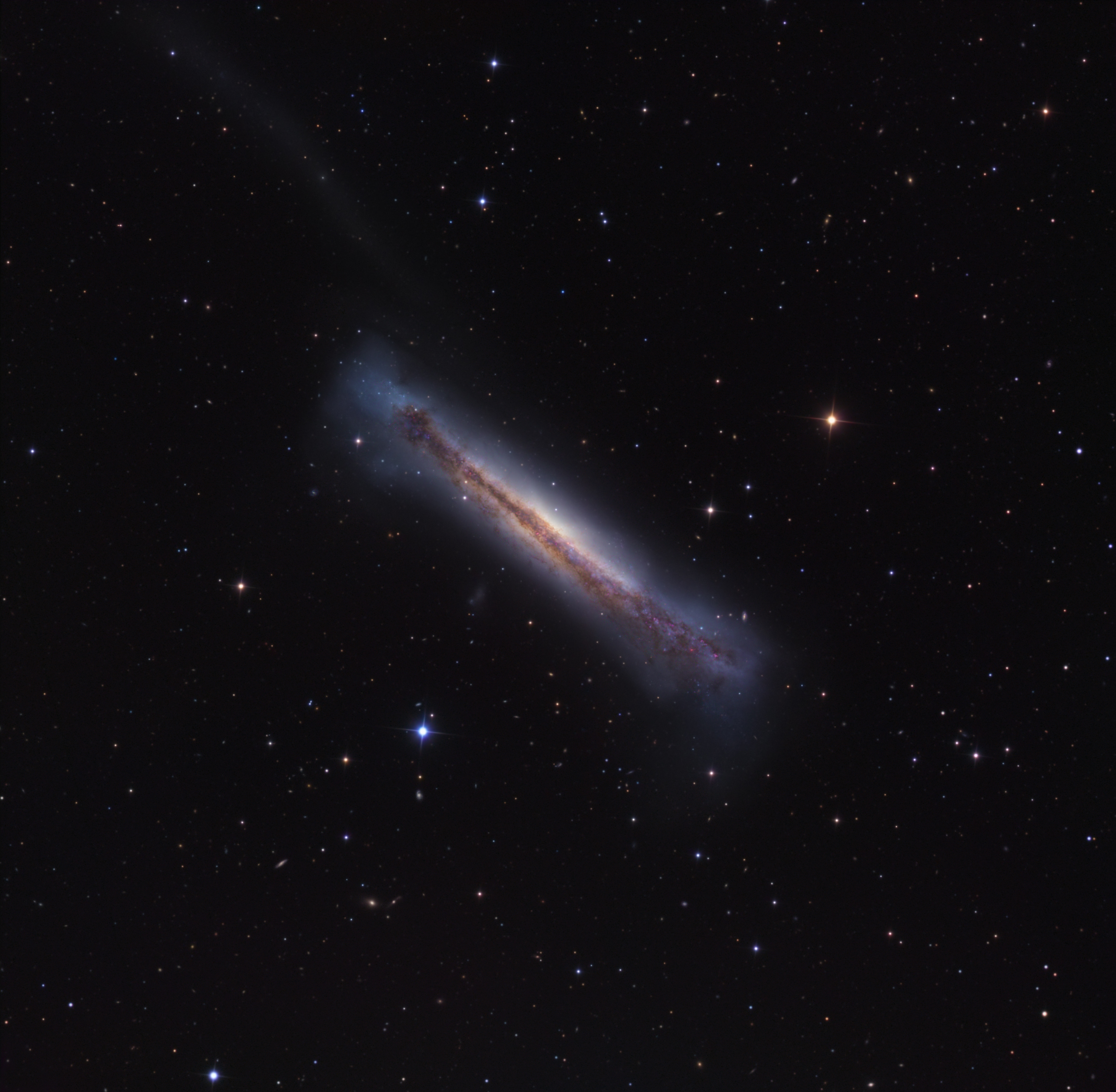
Spiral galaxies, looked at from the side, always provide an interesting perspective on their shape and composition. NGC 3628, located 35 million light years away, is located in the constellation Leo the Lion. Its massive distance alone is fascinating, and that we are able to get such a clear picture of it gives an idea of how luminous this galaxy must be. The tail of the galaxies are slowly being pulled apart, leading many scientists to believe that nearby objects are pulling on it, in a constant gravitational interaction. NGC 3628, like the countless other galaxies in the Universe, shows the beauty of a galaxy, a home to countless stars and countless solar systems.
APOD 3.7
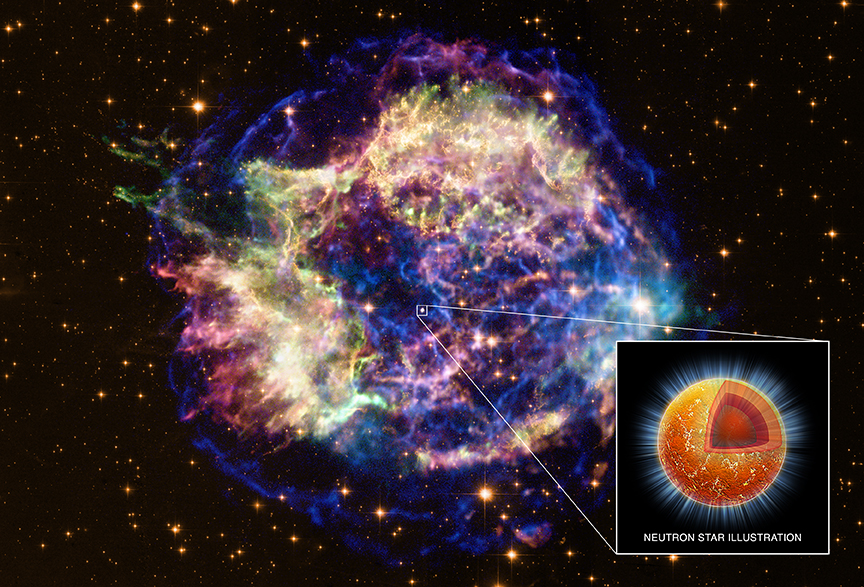 \
\The Supernova remnant Cassiopeia A is extremely relevant in today's Astronomy class because it highlights the formation of a neutron star. 11,000 light years away, this X-ray image shows the beauty of what a supernova creates, with the neutron star nestled in the center, its incredible amounts of energy forming the heaviest elements on the periodic table. The state of the neutron star is believed to be in a frictionless and strange state of matter as it is supercooling, referred to as neutron super-fluid. The objects and matter created within a supernova are still being discovered, as these objects push the Universe to its extremes.
Friday, February 25, 2011
Astronomer Biography Quarter 3: James H. Jeans
James Hopwood Jeans was born in 1877 England, where he excelled in math and sciences. After graduating from Cambridge University in 1898, he became a professor of mathematics at both Princeton University and Cambridge University. Jeans contributed heavily to areas of astronomical physics, however many of his works were ultimately proven wrong, with the exception of a few. However, what some of his incorrect theories did was move science in the right direction. For example, Jeans was able to disprove Laplace’s theory of how the solar system formed. Laplace had determined that the solar system had formed out of a single cloud of gas, which Jeans ultimately concluded to be incorrect. However, Jean’s theory to explain how the solar system is also considered incorrect today, that the planets were all formed from materials that were scattered out by the sun into the solar system after a near-collision with a passing star. So, while Jeans’ theory was ultimately incorrect, it progressed scientific theory on the formation of the Universe.
Another theory Jeans came up with that was ultimately proven wrong was steady state cosmology, the idea that the Universe is constantly expanding, and that new matter is continuously being produced in this expansion. Obviously, this theory does not accept the concept accepted today that matter cannot be created or destroyed, and thus is no longer accepted among the scientific community.
Jean’s biggest accomplishment was his discovery of a formula to find the critical radius of an interstellar cloud in space. A Jeans length is essentially the length an interstellar cloud of dust is capable of being. Any length smaller than a Jeans length will form into a star, and any cloud too large will collapse on itself. Jeans was able to formulate an equation to represent this relationship, which would ultimately come to be known as “Jeans Instability”. This discovery gives astronomers a clear idea of the sizes of interstellar clouds, allowing them to make much more accurate measurements of their sizes.
Over the course of his life, James Jeans joined the ranks of the many great scientists who became a part of the Royal society of England. In 1906 Jeans was first inducted, and over the course of his life there he received many accolades, including the Royal Medal of the Royal Society in 1919, the Gold Medal of the Royal Astronomical Society, and was even knighted in 1928. James Jeans’ biggest accomplishment is certainly his formula for the instability of interstellar clouds, however all of his other discoveries, while ultimately not correct, were vital in the progression of scientific research in those areas. By challenging theories such as Laplace’s on the formation of the Universe, Jeans created a movement into further discovery of how our solar system was formed. Jeans lived during a time of massive scientific discovery, as the ideas surrounding the Universe were being turned upside down on a regular basis. Jeans contributed heavily to this time period of massive scientific discovery, as the world began to finally understand the functioning of the Universe around it.
APOD 3.6

This beautiful photo taken from the Swiss Alps highlights the star clusters that are visible at this time of year in the night time sky. M45 in Taurus, M31 in Andromeda, and M42 in Orion are very clear. M31 is especially clear, the farthest away object in the nighttime sky that is visible to the naked eye.The winter constellations, especially the zodiacal ones, are very clear. This photo highlights what is visible from Earth, and how fascinating the sights are from a good vantage point with minimal light pollution.
APOD 3.5

Lying beneath a spiral galaxy is an enormous object known as Hanny's Voorwerp. Stretching to lengths larger than our own milky way galaxy, the sheer mass of Hanny's Voorwerp can be seen in comparison to the galaxy it rests below. The greenish aurora to the object is due to oxygen particles being illuminated in the visible spectrum. Hanny's Voorwerp is believed to have been a part of the spiral of the galaxy above it (IC2497), but the galaxy collided with another, causing the massive tail to be pulled apart to where it now rests. The sheer size of this object is awe inspiring, a space the size of our galaxy inhabited primarily by oxygen particles.
Subscribe to:
Posts (Atom)