Monday, April 18, 2011
Zooniverse blog entry
I have been focusing on planet hunters for the majority of my Zooniverse career, mainly because its the only one I know how to do properly. I attempted galaxy hunters for a short period of time, but I wasn't entirely sure how to do it so I stopped before I destroyed science as we know it. I'm good at planet hunters, so I've been sticking with it. It is also pretty enjoyable.

Thursday, April 14, 2011
APOD 4.3

This view of Earth is similar to what Yuri Gagarin saw fifty years a go when he became the first man in space. In addition to being the first man in space, he was the first man to get this great view of the Earth. Considering that it was only fifty years ago that the first man was put into space, launched from a ballistic missile, it is pretty remarkable where we have gotten today. Having put a man on the moon, rovers on Mars, satellites spanning our entire solar system, and images that map our universe, it's hard to imagine what the next fifty years of space exploration will bring.
Friday, April 8, 2011
APOD 4.2

The picture shown above is a photo taken by Voyager 2 in 1986 of the largest cliff known in are solar system. Located on Uranus' moon Miranda, Verona Rupes stretches 20 kilometers deep. What I like most about this picture is it touches on how many more mysteries our solar system holds, and how much their is too explore. Even on a Miranda, a moon so distant it is orbiting Uranus, we are able to look into its dark recesses. How the cliff was formed remains a mystery, but something significant must have happened to form a cliff of such a great magnitude. What I also find fascinating about this picture is that we are actually able to see something so distant, and learn about and label a 20 kilometer deep cliff on a distant planet's moon. Sure, we can study galaxies further away, but they stretch hundreds of light years long. Here we are able to view a cliff, which while large in comparison to our cliffs, its size is infinitesimally small in comparison to the surrounding solar system.
Thursday, March 31, 2011
APOD 4.1

This image of the red planet highlights one of its most prominent features: Valles Marineris, a canyon so great it makes the Grand Canyon look like a small hole in the ground. Valles Marineris stretches hundreds of kilometers, and is nearly 10 kilometers deep. Its size is made clear by its incredible presence on Mars. Everything on Mars seems larger in comparison to Earth, containing enormous volcanoes and canyons which puts the Earth's natural landmarks to shame. Besides the view of the canyon, this picture of Mars is also particularly enigmatic, showing beauty in the cold and barren planet. Mars truly is an incredible sight, Valles Marineris just being one aspect that makes it so incredible.
Monday, March 28, 2011
Observation 3/26
The big astronomy night was on Saturday, and it was the clearest night you could ask for. Over the course of the night I became familiar with all the winter constellations, observing the "Heavenly G", containing the brightest star Sirius in Canis Major, the great red star Betelgeuse in Orion along with Rigel, Caster and Pollux in Gemini, and I also managed to locate Procyon in Canis Minor. The most fascinating aspect of the night, however, was looking at Saturn, up close through the telescopes. I have never seen Saturn in person before, and the clarity of its rings and moons was fascinating. I never realized Saturn's rings were so clear and so massive in comparison to the planet when viewed on the visible spectrum. The rings of Saturn were truly awe inspiring, and was the best part of the stargaze for me.
Friday, March 18, 2011
APOD 3.8
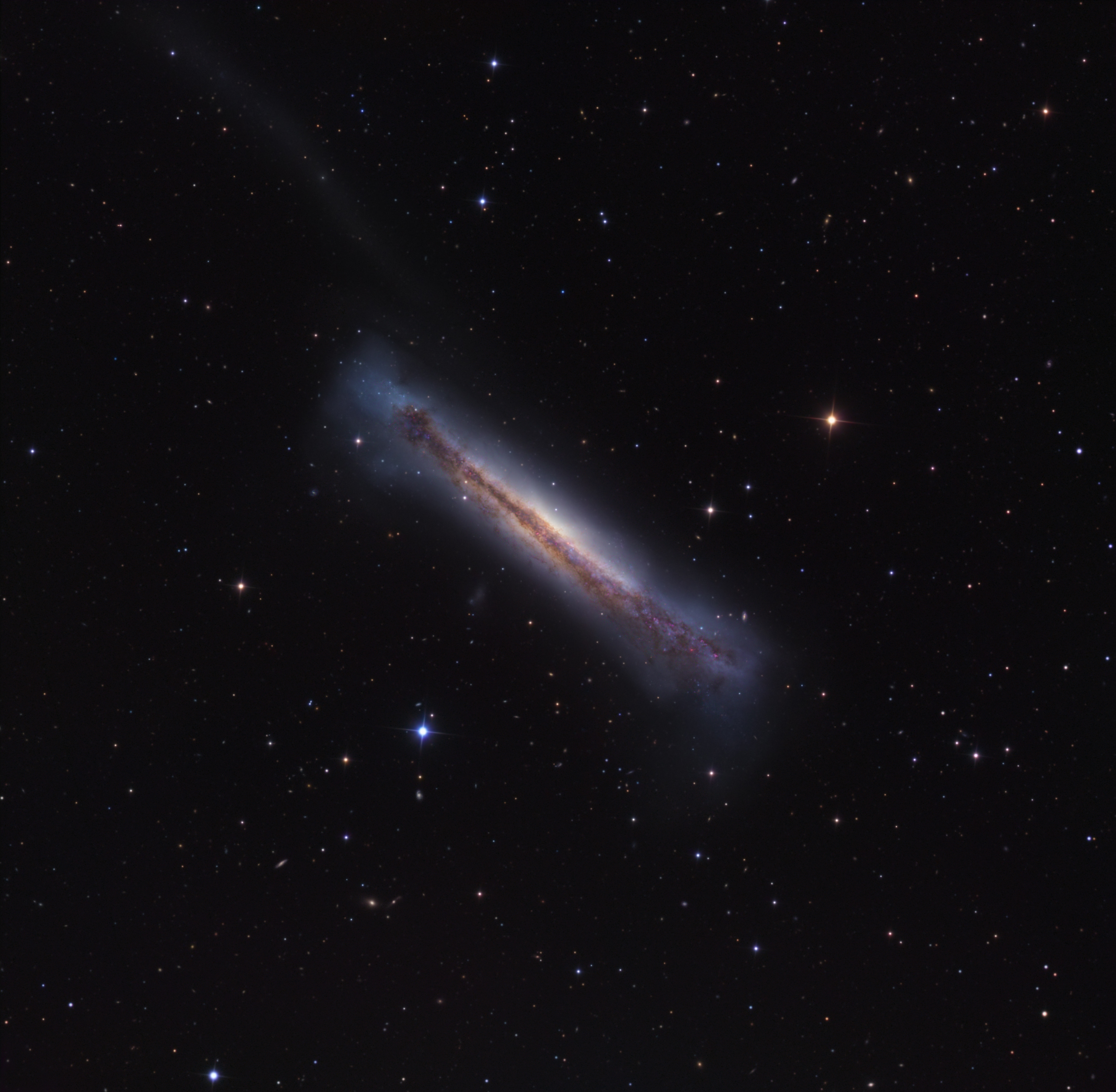
Spiral galaxies, looked at from the side, always provide an interesting perspective on their shape and composition. NGC 3628, located 35 million light years away, is located in the constellation Leo the Lion. Its massive distance alone is fascinating, and that we are able to get such a clear picture of it gives an idea of how luminous this galaxy must be. The tail of the galaxies are slowly being pulled apart, leading many scientists to believe that nearby objects are pulling on it, in a constant gravitational interaction. NGC 3628, like the countless other galaxies in the Universe, shows the beauty of a galaxy, a home to countless stars and countless solar systems.
APOD 3.7
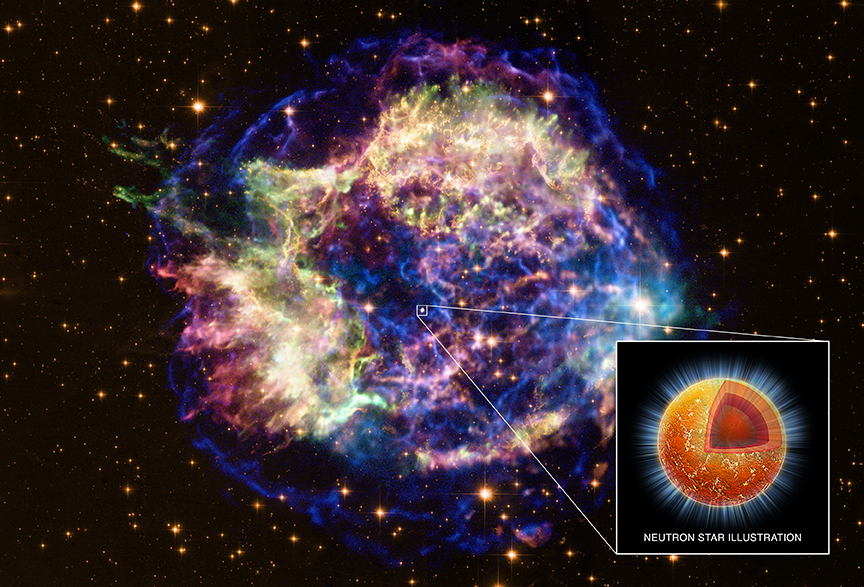 \
The Supernova remnant Cassiopeia A is extremely relevant in today's Astronomy class because it highlights the formation of a neutron star. 11,000 light years away, this X-ray image shows the beauty of what a supernova creates, with the neutron star nestled in the center, its incredible amounts of energy forming the heaviest elements on the periodic table. The state of the neutron star is believed to be in a frictionless and strange state of matter as it is supercooling, referred to as neutron super-fluid. The objects and matter created within a supernova are still being discovered, as these objects push the Universe to its extremes.
Subscribe to:
Posts (Atom)